
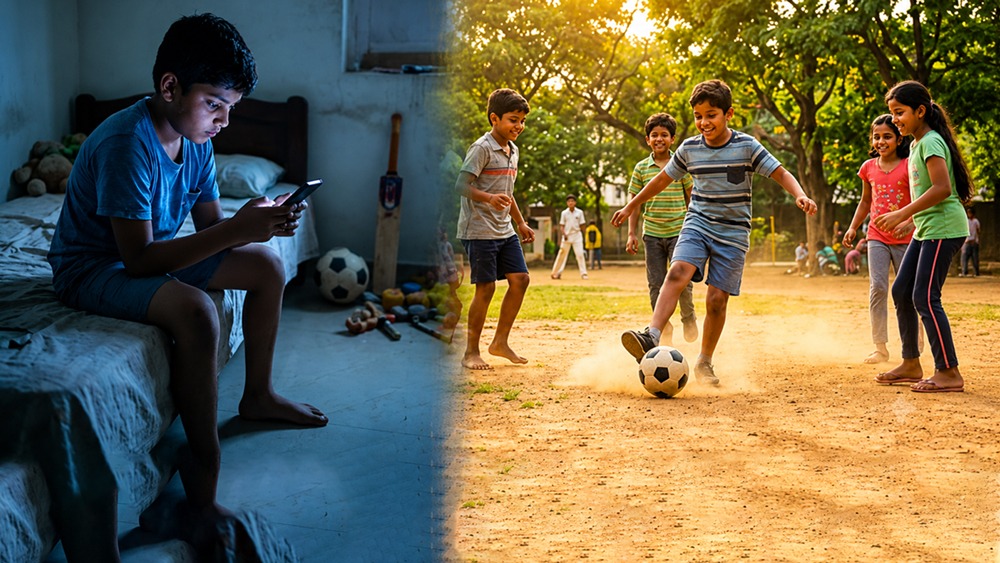
There was a time when play just happened on its own. Children ran outside after school, disappeared into games, came back tired, dirty, and somehow calmer. Now things feel different. Screens are everywhere, and honestly, they are not going away. Even adults reach for a phone without thinking. So when parents start worrying about screen time vs. playtime, the question usually feels bigger than just “How many hours is too much?” It feels more personal than that. At The Arthah School, we often notice that children are not asking to avoid screens completely. They are asking for balance, even if they do not know how to say it. A child may enjoy a coding activity in a smart classroom and still need an hour to run freely in a kids’ play area afterwards. Both experiences shape them differently. The difficult part is that screens are not entirely bad, and play is not always simple anymore.
Screens hold attention very easily. That is true for adults, too. Bright colours, fast responses, endless videos, everything is designed to keep children engaged. Sometimes it even looks productive. A child learning through an educational app can seem more focused than a child building random things with blocks on the floor. But quiet play often does not look impressive from the outside.
At The Arthah School, we keep thinking about this because learning today cannot ignore technology. Our classrooms are AI-native and human-led, which means technology supports learning, but relationships still matter most. Children need digital awareness because the world they are growing into will expect it from them. Still, too much screen exposure can slowly reduce patience, movement, imagination, and even simple conversations at home. That balance becomes important much earlier than people expect.
A child playing outdoors is not “doing nothing.” That is the part many people miss. When children climb, argue during games, invent stories, lose races, or make up rules, something deeper is happening. That is where confidence starts forming naturally. That is where emotional resilience quietly grows. At The Arthah School, movement and physical expression are part of everyday learning because we believe real growth cannot happen only while sitting still. Our sports spaces, storytelling rooms, makers spaces, and creative programs are designed around the idea that children learn with their bodies, emotions, and curiosity, too.
This is why conversations around skill development for students cannot stay limited to marks or digital learning. A child also develops skills during unstructured play. Teamwork appears there. Problem-solving appears there. Leadership appears there in very small ways. Sometimes the most important learning happens when adults are not directing every minute.
It is easy to turn this into a debate where screens are bad and outdoor play is good. Real life is rarely that neat. A child learning robotics may feel genuinely inspired. Another child may discover creativity through animation or storytelling apps. Technology can open doors when used thoughtfully. At The Arthah School, we use smart classrooms, robotics labs, and integrated learning spaces because children should feel prepared for the future, not disconnected from it.
But preparation for the future should not cost childhood. That is why we keep returning to the idea of rhythm instead of restriction. A healthy day for a child usually includes different kinds of experiences, focused learning, movement, boredom, conversation, creativity, rest, and free play. Even summer camp activities often work well because they naturally mix these experiences without making learning feel forced. Children do not always need constant entertainment. Sometimes they just need space.
Many parents are not searching for perfect rules anymore. They are searching for reassurance that their child is growing well. That is probably why schools today are being looked at differently, too. Families want places that care about emotional well-being, creativity, confidence, and values alongside academics. The conversation is slowly shifting toward the holistic development of students rather than only exam performance. As a progressive CBSE school, we at The Arthah School think this matters deeply. A child who feels emotionally safe usually learns better.
A child who plays regularly often handles stress better, too. Even personality development for students begins in ordinary conversations, teamwork, storytelling, movement, curiosity, and feeling heard. This is also why many families searching for CBSE schools in Kollur, Hyderabad, are now asking questions beyond academics. They want to know how children spend their day. They want to know whether there is space to breathe, move, learn, and simply be children. That question matters.
At The Arthah School, balance is not treated like a strict formula. Every child is different. Some children need more movement. Some need more creative expression. Some naturally enjoy technology, while others connect more through art, storytelling, or sports. Our 7+ acre campus in Kollur was designed with this understanding in mind. We wanted learning spaces that feel alive, not mechanical. Smart classrooms exist alongside open playfields.
Robotics labs exist alongside storytelling rooms and performing arts spaces. Structured academics exist alongside sports, collaboration, and exploration. As one of the emerging best CBSE schools in Kollur, Hyderabad, we believe children should grow into capable, future-ready individuals without losing their sense of wonder along the way. That balance feels important now more than ever.
Children probably do not need a childhood without screens. That is no longer realistic. What they do need is a childhood where screens are not replacing everything else. They still need scraped knees sometimes. They still need conversations at dinner. They still need boredom, imagination, movement, laughter, and friendships that happen away from devices. The balance between screens and play may never look the same in every home. But when children feel connected, active, curious, and emotionally secure, something usually starts falling into place naturally. And maybe that is what most parents are truly hoping for in the end.